I am a Christian. I believe in the God of the Bible, in God the Father, in His Son Jesus Christ, and in the Holy Spirit. I believe in Genesis 1:1 - "In the beginning God created the heavens and the earth. (NIV)" I am a biochemist and a pharmacist by education. As such I have a desire to understand nature. I am writing this blog as my way to express the facts of true science as I understand them, from the perspective of one who believes that all things were created by God, for God and for His purposes.

Feel free to comment, to offer your perspective, or to give suggestions for subjects.
Please take a minute to "Like" us on Facebook.

Wednesday, March 9, 2016

Are Nature's Other Sweeteners Better?

The room had no windows. It was dark, except for a lone covered incandescent that hung by a wire from the ceiling. Its light shown on an old square table and a battered wooden chair in the middle of the room. Moving close, the detective grabbed the shade and bent the glaring beam into the face of the accused, getting almost nose to nose with the suspect sitting hunched over in the chair. "Where were you on the night of the 21st?" he asked in an accusatory tone. "I've been framed" said the perpetrator. The detective knew the case was weak but everyone was looking for someone to pin this crime on, anyone but themselves...

And so starts the story of how Sugar became a bad word in the dietary world and a string of alternatives were born. Are they any better? We will look at the natural alternatives to sugar in this story and see if we can find any benefits or uncover any harm to replacing sugar in our diets.

The main suspects in this story are:

  • Honey
  • Corn Syrup
  • High Fructose Corn Syrup (HFCS)
  • Agave Nectar (syrup)

Honey is a sweet food made by bees from the nectar of flowers. The variety produced by honey bees (the genus Apis) is the one most commonly referred to, as it is the type of honey collected by most beekeepers and consumed by people. Honeys are also produced by other hymenopteran insects, though in much lower quantities and with slightly different properties compared to honey from bees. Honey bees convert nectar into honey by regurgitation and evaporation and store it as a primary food source in wax honeycombs inside the beehive.

Honey gets its sweetness from fructose and glucose. It has a slightly higher ratio of fructose to glucose than table sugar, close to 1.2:1, depending on the source. This makes honey slightly sweeter than sugar, thus less is required. Honey has attractive chemical properties for baking and a distinctive flavor that leads some people to prefer it over sugar and other sweeteners. Most microorganisms do not grow in honey because of its low water content (< 20%) but it sometimes contains dormant endospores of the bacterium Clostridium botulinum, which can be dangerous to infants (botulism). Because it is a natural product by definition, the types and percentages of sugars contained can vary greatly depending on the source of the honey. It also can contain other ingredients, such as organic and amino acids, antioxidants, proteins, as well as trace amounts of vitamins and minerals.

Honey is available in many forms and nectar types. The most common form is filtered and pasteurized honey, the kind usually found at the market, which is generally a clear or slightly opaque amber liquid. Another popular form is raw or unfiltered honey which typically will contain crystals of glucose and may appear solid.


The Problem is not the Sugars Themselves
It is Eating Too Many Empty Sugar Calories

Corn syrup is a food syrup which is made from corn starch. It softens texture, adds volume, prevents crystallization of sugar, and enhances flavor. It contains primarily glucose, maltose and longer chain oligosaccharides. It is made by enzymatically splitting the long chain starch molecules. It does not naturally contain fructose. It can be found in your local market flavored with Vanilla or Molasses. It is a pure syrup. It does not naturally contain any proteins, vitamins or minerals.

High-fructose corn syrup (HFCS) is a sweetener made from corn syrup that has been further processed by glucose isomerase to convert some of its glucose into fructose. HFCS was first marketed in the early 1970s by the Clinton Corn Processing Company, together with the Japanese research institute where the enzyme was discovered.

As a sweetener, HFCS is often compared to granulated sugar. Advantages of HFCS over granulated sugar include being easier to handle, and being less expensive in some countries. However, there is also widespread debate concerning whether HFCS presents greater health risks than other sweeteners. Use of HFCS peaked in the late 1990s; demand decreased due to public concern about a possible link between HFCS and metabolic diseases like obesity and diabetes. It contains either 42% or 55% fructose, with the remaining sugar primarily as glucose. In reality it is much closer to table sugar in its fructose/glucose composition.

Agave nectar (more accurately called Agave syrup) is a sweetener commercially produced from several species of agave, including Agave tequilana (blue agave) and Agave salmiana. Agave syrup is sweeter than honey due to its higher fructose concentration and tends to be less viscous. Most Agave syrup comes from Mexico and South Africa. It is considered a "natural" sweetener by some but is more processed than table sugar.

Agave syrup has been marketed as a "healthful" sweetener due to the low glycemic index of fructose. This concept has been criticized due to its very high fructose content, even higher than high fructose corn syrup, and its potential to lead to insulin resistance and significantly increased triglyceride level, a risk factor for heart disease. Agave syrup, depending on the method of preparation, has anywhere from 56% to as much as 90% fructose.

Overall there is strong scientific evidence that the over-consumption of added sugars, as sucrose or any of these other sweeteners, is a major health problem. Consuming empty sugar calories, especially in the form of soft drinks, is strongly linked to obesity. The World Health Organization has recommended that people limit their consumption of added sugars to 10% of total calories, but typical consumption of empty calories in the United States is nearly twice that level.

Excessive sugar or glucose intake can lead to obesity and Type 2 Diabetes. Fructose does not affect insulin levels, is metabolized mainly in the liver. It is converted into triglycerides and stored as fat. Excess fructose increases the likelihood of fatty liver disease and insulin resistance.

Fructose is sweeter than sucrose or glucose so products high in fructose taste sweeter and smaller amounts may be used. Percentages listed below can vary as some of these products are more natural or less processed than regular sugar.

Carbohydrate Percentages
Average
Carbohydrates(%)
    Fructose         Glucose       Sucrose     Maltose    Oligosaccharides 
Honey 38.2% 31.3% 1.3% 7.1% 1.5%
Corn Syrup 0.0% 26.0% 0.0% 24.0% 50.0%
HFCS 42% or 55% 53% or 40% 0.0% 0.0% 5.0%
Agave Syrup 56%-90% <20% 0.0% 0.0% 5%-30%

A plethora of variations of these syrups and other carbohydrates are used in the food industry to improve the sweetness, texture, appearance or shelf life of many products. Other than the fact that Honey does contain some beneficial impurities (amino acids, vitamins and minerals), and less fructose seems to be better, any of these can be used in place of sugar. The real perpetrator in this case is excess carbohydrate consumption and your body is the victim. You need to check the calories as carbohydrates and look at the ingredient list to see where sugar or HFCS is listed to help reduce your carb calories.

Proverbs 16:24 (NLT) - Kind words are like honey — sweet to the soul and healthy for the body.

Proverbs 25:16 (NLT) - Do you like honey? Don't eat too much, or it will make you sick!

Sunday, January 31, 2016

How Sweet It Is!

Jackie Gleason, of "The Honeymooners" fame, would often say "How Sweet It Is!" when talking about life and love. He played Ralph Kramden, the short-tempered yet kind-hearted bus driver for the Gotham Bus Company. He was always working on get-rich-quick schemes with his best friend Ed Norton.
Jackie was born and raised in Brooklyn. His quote is on a street sign welcoming visitors to the city when they cross the Brooklyn Bridge.

He also is quoted as saying: "Our dreams are firsthand creations, rather than residues of waking life. We have the capacity for infinite creativity; at least while dreaming, we partake of the power of the Spirit, the infinite Godhead that creates the cosmos." showing that he believed that we can be connected with God at least in our dreams, if not in our daily work.

Welcome to Brooklyn road sign
by Sledgeh101

Like Jackie's quote, we sometimes talk of sugar as "How Sweet It Is!", using it as the standard of sweetness for other substances. But sugar is more than that! It is an essential source of energy that supports life as we know it. Scientifically, we use sugar as a general name for the sweet, short-chain, soluble carbohydrates found in many foods.

There are various types of sugar. Simple sugars are called monosaccharides and include glucose (also known as dextrose), fructose and galactose. The white or granulated sugar most customarily used in foods is sucrose, a disaccharide. Other disaccharides include maltose and lactose. Glucose, found in all three of the disaccaharides mentioned, is one of the primary sources of energy in our bodies.

  • Lactose (Milk Sugar) = galactose + glucose
  • Maltose (Starch Sugar) = glucose + glucose
  • Sucrose (Cane or Beet sugar) = fructose + glucose

Lactose is the naturally occurring sugar found in milk. A molecule of lactose is formed by the combination of a molecule of galactose with a molecule of glucose. Lactose is broken down during digestion into its constituent parts by the enzyme lactase. Children have this enzyme but some adults no longer form it and they are unable to digest lactose (lactose intolerant).

Maltose is formed by the combination of two molecules of glucose. It is less sweet than glucose, fructose or sucrose. It is formed in the body during the digestion of starch by the enzyme amylase and is itself broken down during digestion by the enzyme maltase. Starch is composed mainly of long chains of glucose molecules.

Sucrose occurs naturally alongside fructose and glucose in other plants, in particular fruits and some roots such as carrots. The different proportions of sugars found in these foods determines the range of sweetness you experience when eating them. A molecule of sucrose is formed by the combination of a molecule of glucose with a molecule of fructose.

Although sucrose is found in many plants, it exists only in sufficient concentrations for commercial extraction in sugar cane and sugar beet. Sugar cane is cultivated in the tropical climates of Southeast Asia, the West Indies and Americas. Sugar beet is grown in cooler climates.

A method to crystallize sugar was discovered in India around the 5th century AD. It produced crystals that were called, in the local language, "khanda" which is the source of our word, candy. The evolution of taste and the demand for sugar as an essential food ingredient unleashed major economic and social changes. Sugar production and trade changed the course of human history, influenced the formation of colonies and the migration of peoples, resulted in wars between sugar trading nations, and impacted the ethnic composition and political structure of the New World.

Today we are focusing mainly on sugar as sucrose and its two monosaccharides, glucose and frutose.

Sugar as sucrose is refined from sugar cane and sugar beets. Most sugar used in the Western world is derived from sugar cane (80%). Beet sugar is extracted from the roots by diffusion to produce a juice which is then treated with calcium hydroxide and carbonatation to produce a pure sugar liquid. Water is then removed by boiling the juice in a vacuum and pure sucrose crystals are formed by seeding the resulting syrup. The crystals formed are relatively pure sucrose and are generally not refined further.

Sugar from sugar cane is treated in a similar fashion except that the final crystals are not as pure, but have a sticky brown coating. This sugar can either be used as is (raw or Turbinado sugar) or further refined to remove this coating. The by-product of the refining process results in molasses which contains significant amounts of vitamin B6 and minerals, including calcium, magnesium, iron, manganese, and potassium. Brown sugar is typically produced by taking refined sugar and adding back some of the molasses although raw or Turbinado sugar can be considered "brown" sugar as the molasses has not been fully extracted. Raw sugars are touted as more healthy though really are not significantly different than commercially prepared brown sugar.

When baking with sugar, some recipes call for one sugar or the other, brown or white, or a combination. Slightly acidic brown sugar causes baked goods to rise higher since it activates any baking soda in the recipe. It also retains moisture. White sugar is not acidic and adds no leavening power, so you end up with less rise and a crisper crust. Sometimes it is possible to substitute one for the other, or even to use fruit juices or apple sauce to replace the sugar and get more nutrients into the finished baked goods.

Heating also impacts the taste and texture of foods containing sugar. As sugar caramelizes, it turns brown and breaks down into a complex chemical mixture that produces the caramel flavor and brown color. Caramelization is a reaction between different types of sugars and usually is used to produce that sweet confection, Caramel. It is the result of Pyrolysis. This process is somewhat different than the Maillard Reaction which is a chemical reaction between sugars and amino acids. This reaction is what makes the tasty brown goodness of a well seared steak or the crunchy brown crust on your favorite french fries.

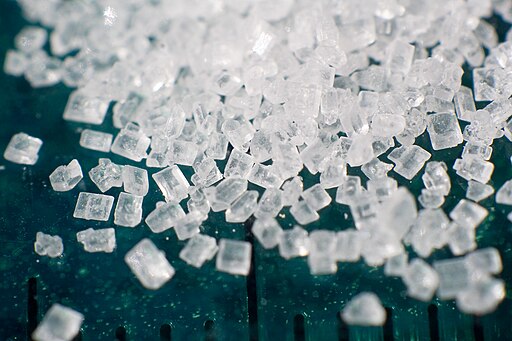
Sugar (sucrose - see photo) contains one molecule of fructose and one molecule of glucose with a chemical formula of C12H22O11. By enzymatic action, our body breaks down sucrose into these two monosaccharides during digestion. The resulting fructose and glucose molecules are then rapidly absorbed into the bloodstream. Glucose is taken up directly into the cells while fructose passes to the liver, where it is metabolized into triglycerides. Sugar 2xmacro
Magnification of grains of refined sucrose

Fructose and glucose are simple sugars with the same chemical formula C6H12O6 although they have different structures (see illustration above). They have five hydroxyl groups (−OH) and a carbonyl group (C=O) and are cyclic when dissolved in water. They each exist as isomers with dextro- and levo-rotatory forms that cause polarized light to diverge to the right or the left. The dextro- isomers (e.g. dextrose) are the ones commonly found in nature. Fructose, or fruit sugar, occurs naturally in fruits, some root vegetables, cane sugar and honey and is the sweetest of the sugars. It is the primary component of high-fructose corn syrup, which is manufactured from hydrolyzed corn starch. Glucose, or dextrose, occurs naturally in fruits and plant juices and is the primary product of photosynthesis. Most ingested carbohydrates are converted into glucose during digestion and it is the main form of sugar that is transported by the bloodstream. It can be manufactured from starch by enzymatic hydrolysis.

The average person consumes about 75gm of refined sugars each day, equal to 15 teaspoonfuls. At 4 calories per gram, this is and extra 300 calories a day! This is more than double the recommended allowance. Since the latter part of the twentieth century, it has been questioned whether a diet high in sugars, especially refined sugars, is good for human health and may potentially be a cause of obesity.

Much ado has been made of sugar but most other natural sweeteners are also a combination of glucose and fructose. Sucrose is 50% glucose and 50% fructose. Honey, Agave nectar, invert sugar and high fructose corn syrup all contain similar mixtures of these two simple sugars. Substituting one of these for sugar still results in the same number of extra calories. We will cover these alternative natural sweeteners (and others, including artificial sweeteners) in subsequent blogs.

One main concern with excessive intake of these sugars is their metabolism. Glucose is mainly used directly as a source of energy and causes the release of insulin into the bloodstream. Insulin is required for cells to absorb glucose. Chronic excess glucose in the bloodstream is call hyperglycemia. Excessive sugar or glucose intake can lead to obesity and Type 2 Diabetes. Fructose does not affect insulin levels and is metabolized mainly in the liver and is converted into triglycerides. Excess fructose increases the likelihood of fatty liver disease and insulin resistance.

Table 1. Sugar content of selected common plant foods (g/100g)[Ref]
Food Item Total
 Carbs 
Total
 Sugars 
Free
 Fructose 
Free
 Glucose 
 Sucrose   Fructose/ 
Glucose
Ratio
Sucrose
as a % of
 Total Sugars 
     Fruits
Apple 13.8 10.4 5.9 2.4 2.1 2.0 19.9
Apricot 11.1 9.2 0.9 2.4 5.9 0.7 63.5
Banana 22.8 12.2 4.9 5.0 2.4 1.0 20.0
Fig, dried 63.9 47.9 22.9 24.8 0.9 0.93 0.15
Grapes 18.1 15.5 8.1 7.2 0.2 1.1 1
Navel orange 12.5 8.5 2.25 2.0 4.3 1.1 50.4
Peach 9.5 8.4 1.5 2.0 4.8 0.9 56.7
Pear 15.5 9.8 6.2 2.8 0.8 2.1 8.0
Pineapple 13.1 9.9 2.1 1.7 6.0 1.1 60.8
Plum 11.4 9.9 3.1 5.1 1.6 0.66 16.2
     Vegetables
Beet, Red 9.6 6.8 0.1 0.1 6.5 1.0 96.2
Carrot 9.6 4.7 0.6 0.6 3.6 1.0 77
Corn, Sweet 19.0 6.2 1.9 3.4 0.9 0.61 15.0
Red Pepper 6.0 4.2 2.3 1.9 0.0 1.2 0.0
Onion, Sweet 7.6 5.0 2.0 2.3 0.7 0.9 14.3
Sweet Potato 20.1 4.2 0.7 1.0 2.5 0.9 60.3
Yam 27.9 0.5 trace trace trace na trace
Sugar Cane 13-18 0.2-1.0 0.2-1.0 11-16 1.0 high
Sugar Beet 17-18 0.1-0.5 0.1-0.5 16-17 1.0 high

The best way to get sugars into your diet is naturally. Refined sugar is considered to be just empty calories and it lacks the nutrients that could be obtained by getting our daily allowance from fruits and vegetables. As you can see from the table above, many fruits and vegetables are good, balanced sources of sugars. Avoid sugary soft drinks and even many fruit juices and smoothies as they are heavier in sugars than the raw fruits and many have added sugars. God gave us the plants for food, enjoy them as close to their natural state as possible!

Genesis 1:29 (NLT) Then God said, “Look! I have given you every seed-bearing plant throughout the earth and all the fruit trees for your food.

Proverbs 24:14 (NLT) In the same way, wisdom is sweet to your soul. If you find it, you will have a bright future, and your hopes will not be cut short.

Friday, January 15, 2016

The Chemistry of Pruning

Nowadays everyone wants to eat more healthy, get fresh produce, and go to farmer’s markets or specialty grocers, searching for organic fruits and vegetables.

Many are even digging up their lawns and landscapes to plant small gardens at home, just to get the freshest produce they can find. Some will grow just a few things like herbs and tomatoes. Others will plant a massive spread to fill their tables.

Want luscious tomatoes, juicy apples or prize-winning pumpkins growing in your garden? It doesn't matter if you want to grow a tree, shrub, or vine, flowers, fruit or vegetables, you need to prune your plants. Trim and thin. Increase the symmetry and the yield. By proper pruning you will be able to make your plants healthier, more productive and more attractive.

To prune you need to do these four things:

  • Trim the dead wood
  • Thin out the extra growth
  • Cut out the suckers
  • Snip back to a bud

When trimming the dead branches, any time of year is fine. Cutting back the dead to live foliage will generally stimulate more shoots and help to shape the plant.

Thinning out dense growth, be it clearing weaker branches or removing excess edible produce, lets in more sunlight to the remaining vegetation. This gives the plant more energy to grow. Select the biggest and best of the yield, snipping off the rest.

Suckers “suck” the life from the plant and can take away from the beauty or the bounty. They tend to be weaker and less productive than the main shoots and should be removed.

Finally, clipping to a bud reduces extraneous shoots and gets the growth started again quickly. This also encourages more blooms.

All of these techniques focus on making the plant more beautiful and productive, increasing the harvest or the appearance of the plant.


…nothing in all creation will ever be able
to separate us from the love of God…
Romans 8:39 (NLT)

In much the same way God prunes the ones He loves to make them more fit for His Kingdom and His work. Jesus even referred to Himself as part of the plant from which we grow.

In John 15:2 (NIV) Jesus says: “He cuts off every branch in me that bears no fruit, while every branch that does bear fruit he prunes so that it will be even more fruitful.”

And in John 15:5 (NIV) Jesus says: “I am the vine; you are the branches. If you remain in me and I in you, you will bear much fruit; apart from me you can do nothing.”

God tells us what fruit He wants us to bear for His Kingdom, the fruit of the Spirit:

Galatians 5:22 (NIV): The fruit of the Spirit is love, joy, peace, forbearance, kindness, goodness, faithfulness, gentleness and self-control.

So that we can live worthy of Him:

Colossians 1:10 (NIV): So that you may live a life worthy of the Lord and please him in every way: bearing fruit in every good work, growing in the knowledge of God,

God directs us, through repentance and by faith, to yield good fruit for His harvest.

Matthew 3:8 (NIV): Produce fruit in keeping with repentance.

Matthew 12:33 (NIV): “Make a tree good and its fruit will be good, or make a tree bad and its fruit will be bad, for a tree is recognized by its fruit.”

John 15:8 (NIV): This is to my Father’s glory, that you bear much fruit, showing yourselves to be my disciples.

The Greek word for “prune” is “Kathairō” which means “to cleanse of impurities.” God does a good work in us so we may be clean and He will continue it until all impurities are gone.

He who began a good work in you will carry it on to completion until the day of Christ Jesus. - Philippians 1:6 (NIV)

There is nothing that can take away His love for us.

Romans 8:39 (NLT): …nothing in all creation will ever be able to separate us from the love of God…

Saturday, January 2, 2016

Happy New Year!

Happy New Year to all who read this! I want to thank all of my subscribers and those who have been coming here to read my posts over the years. It has been almost two and a half years since I wrote my last post and more than three and a half years since I was writing regularly. In spite of this I continue to have many visitors each month, with some writing supporting comments about how they enjoyed the blog. I am hoping to begin to write more soon, but at a slower pace than before, posting monthly.


Lift up your voice with a shout,
lift it up, do not be afraid.
The LORD is the everlasting God,
the Creator of the ends of the earth.


I was reading Isaiah recently and these verses from Isaiah 40 caught my eye and have prompted me to start again on this blog:

God is our Creator and the Creator of all things. It is He who we worship.

Isaiah 40:26 (NIV) Lift up your eyes and look to the heavens: Who created all these? He who brings out the starry host one by one and calls forth each of them by name. Because of his great power and mighty strength, not one of them is missing.

Isaiah 40:28 (NIV) Do you not know? Have you not heard? The LORD is the everlasting God, the Creator of the ends of the earth. He will not grow tired or weary, and his understanding no one can fathom.

And He calls us to proclaim it from the mountain tops!

Isaiah 40:9 (NIV) You who bring good news to Zion, go up on a high mountain. You who bring good news to Jerusalem, lift up your voice with a shout, lift it up, do not be afraid; say to the towns of Judah, “Here is your God!”

I am hoping to add my voice to the shouting of the "Good News" again this year.

Monday, September 2, 2013

Balance and Equilibrium - the Chemistry of pH

Where I work there is frequent talk of "Work/Life Balance", balancing our time between the two, you know like "All work and no play makes Jack a dull boy." Well that is easier said than done! These days work and home life can both be very stressful. Sometimes it is easier to go to work after a hectic vacation because we fill our personal lives up with so much that it can be a break to go back to work! You can feel like you have to "punch the clock" at home just as you do at work.

In some ways, pH is like that, it is a balancing act of Hydrogen ions, H+, and Hydroxy ions, OH-, in water. You might remember from high school that pH stands for the inverse of the "parts Hydrogen" or “power of Hydrogen” in a solution. A pH of 1 is 1 part (mols) of H+ per ten parts (liters) water or a concentration of 10-1 Hydrogen ions. The pH scale is a measure of the hydrogen ion concentration in water. Scientifically it is expressed as the negative log10 of [H+] (in mols/liter).

Thinking of the pH of a liquid, it can span a scale from 0 to 14 with the middle point (pH 7) being neutral. Any pH number greater than 7 is considered basic and any pH number less than 7 is considered acidic. Each whole pH value below 7 is ten times more acidic than the next higher value. For example, a pH of 4 is ten times more acidic than a pH of 5 and 100 times (10 times 10) more acidic than a pH of 6. The same holds true going up the scale for pH values above 7, each of which is ten times more alkaline - another way to say basic - than the next lower whole value.

The word "balance", as in pH balanced - think skin cleansers and shampoo, suggests a static condition, like Lady Justice holding the scales in her hands or when we balance hours in a day - eight hours at work, eight hours at home (life) and eight hours sleeping.

In our spiritual life balance would equate to keeping the Ten Commandments. Of course I can refrain from murder or adultery in the strictest sense and can keep what appears to be the letter of the law, balancing my sins with good behavior. This is the "Works" mentality - if I am good enough and my good outweighs my bad, on what I think is the scale of God's Justice, I will go to Heaven. But Galatians 2:16 (NIV) says "Know that a person is not justified by the works of the law, but by faith in Jesus Christ." and Romans 3:20 (NIV) says "Therefore no one will be declared righteous in God's sight by the works of the law; rather, through the law we become conscious of our sin."

There is more to life - physically and spiritually, and to pH, than just balancing the hours, good deeds or Hydrogen ions. Life and pH are dynamic conditions where things are constantly changing, even when they appear to be in balance. When from the outside looking in everything appears to be in balance, in spite of constant changes, we call it "equilibrium."

Equilibrium is when a system appears in a state of balance because opposing forces cancel one another out or reversible reactions take place at equal rates. You can see this when trying to ”balance” on one foot. You feel your muscles constantly shifting ever so slightly to keep your body stable. The pH of a solution actually is not a static group of Hydrogen ions floating around in a pool of water. The positive Hydrogen ions are constantly combining with and separating from the negatively charged Hydroxy ions (or other ions in solution) in a chemical dance that maintains what appears to be a balanced system.

God too wants our lives to be in equilibrium, keeping things in balance by constantly adjusting to the changes in life. He gave us the Ten Commandments, not as a set of rules to follow but, as a basis for us to see our weaknesses and how far we are from His righteousness. Although we might not murder, we can and do get angry with our brother and thus fall short. But if our hearts are constantly striving to be like Jesus, we will repent and keep our "spiritual pH" in equilibrium with God.

He wants us to be constantly balancing our spiritual with our physical in such a way as to shine His light upon the darkness. Colossians 3:2 (NKJV) says “Set your mind on things above, not on the things that are on earth” and 1 John 2:15a & 17b (NKJV) says "Do not love the world or the things in the world... but he who does the will of God abides forever." I am sure you have heard it said "don't be so heavenly minded that you are no earthly good." Well we must be heavenly minded to do any earthly good but not to the point where we miss the purpose God has for putting us here in the first place! James 2:22 (NIV) says "You see that his (Abraham's) faith and his actions were working together, and his faith was made complete by what he did." Our Faith must be in "equilibrium" with our actions for us to be considered righteous in the eyes of God. James 2:24 (NIV) - "You see that a person is considered righteous by what they do and not by faith alone."


A balanced pH is critical to our physical bodies
as is a balanced spiritual life in Christ
with His Word embedded in our hearts


To our physical bodies, the equilibrium of our internal pH is critical. The acid in our stomachs has a pH of about 3 to help our enzymes digest the foods we eat. With a pH this low, it is no wonder we get heartburn! In our intestines the pH is higher, sometimes crossing from acidic to alkaline, starting about 6 and going up to 8 near the end of the small intestines. This helps our bodies absorb important parts of food, such as vitamins, minerals, proteins, carbohydrates and fats. Our blood has an average pH of 7.4, just slightly alkaline. If our blood pH drops much below this number, it can be very serious. Many of our body’s chemical reactions, especially those involving proteins, are pH-dependent. If the pH drops below 7.0 or rises above 7.8, death may occur. Fortunately, we have buffers in the blood to protect against large changes in our physiological pH.

Buffers are chemicals in a solution that keep the pH from changing when another acidic or basic solution is added. Buffer solutions contain a weak acid/base pair, such as carbonic acid (H2CO3) and bicarbonate (HCO3), a buffer pair that is present in the blood. These acid/base pairs achieve their resistance to pH change because of the equilibrium between the two chemicals. The effect on the pH by the addition of an external solution will be reduced due to this buffering action.

Our spiritual buffer to the words of the world is the Word of God, the Bible. When our spiritual pH moves out of that ideal range, when we are attacked by the enemy, we can buffer those worldly influences by reading and meditating on the Word. It will put our heart back in balance with God's heart. Our body, mind and soul must always be in equilibrium so we can live out Paul's admonition to "Pray without ceasing" (1 Thessalonians 5:17 (KJV)), be in the world but not of the world and be like Christ. Only by meditating on His Word and focusing on the Wisdom He has hidden there, can we truly maintain an equilibrium with the plans He has for us.

Psalms 119:11 (NIV) - I have hidden your Word in my heart that I might not sin against you.
Proverbs 2:10 (NIV) - For wisdom will enter your heart, and knowledge will be pleasant to your soul.
Psalms 56:4 (NIV) - In God, whose Word I praise— in God I trust and am not afraid. What can mere mortals do to me?
Luke 24:27 (NIV) - And beginning with Moses and all the Prophets, He (Jesus) explained to them what was said in all the Scriptures concerning himself.
Colossians 3:16 (NIV) - Let the message of Christ dwell among you richly as you teach and admonish one another with all wisdom through psalms, hymns, and songs from the Spirit, singing to God with gratitude in your hearts.